Learn what is audience segmentation and how to use it to connect with the right people, boost your Facebook engagement, and grow your business organically.
FriendFilter scans your Facebook and shows exactly who's inactive — so you can clean up and boost your reach.
Ever feel like you're shouting into the void on Facebook? You post something you’re genuinely excited about, and all you hear back is... crickets. If that sounds familiar, you’re in the right place. This is where audience segmentation comes in, and it’s simpler than it sounds. It’s the practice of dividing your broad audience (like your entire friends list) into smaller, more specific groups based on who they are and what they do.
For Facebook marketers, coaches, and small business owners, this isn't just some fancy marketing term—it's your secret weapon to finally getting noticed in a crowded news feed and building real connections.
Take a second and think about your Facebook friends list. It's a mix, right? You’ve got your family, old college pals, potential clients for your coaching business, and maybe even that person you met at a networking event five years ago.
Trying to create one single post that resonates with every single one of them is a recipe for disaster. You’ll end up with something so generic it connects with nobody.
Instead of that one-size-fits-all approach, segmentation lets you talk to people about what they actually care about. Imagine your audience is in a stadium. You've got your "Super Fans" in the front row, the "Quiet Observers" way up in the back, and a group of "Potential Clients" in the VIP box. You wouldn't use the same tone or topic for all of them, would you? Of course not.
Segmentation isn’t about excluding people. It's about including them in conversations that actually matter to them. It’s how you turn a faceless crowd into a real, engaged community.
When you share content that hits on a specific group's needs, interests, or pain points, something amazing happens: they engage. Your content feels personal to them because it makes them feel seen and understood.
Let’s quickly look at what this means for your coaching business or brand.
Core Benefits of Audience Segmentation on Facebook
This table offers a quick look at the key advantages of implementing audience segmentation in your Facebook marketing strategy.
By tailoring your approach, you’re not just posting—you’re connecting. This simple shift in strategy can make all the difference.
Understanding who you're talking to is always the first step. The user base on Facebook is incredibly diverse. For instance, in the US, the 25-34 age group makes up 24.2% of all users, while the 18-24 crowd is right behind them at 18.6%.
Knowing little details like this helps you realize that different generations use the platform in fundamentally different ways. Recognizing these nuances is what allows you to craft messages that actually land. If you feel like you're starting from square one, our guide on how to identify your target audience offers a clear roadmap to get you started.
Now that we’ve covered why segmentation is so critical, let's get into the nitty-gritty of how to do it. Think of these four methods as different lenses you can use to understand your audience on a much deeper level. The real magic happens when you start combining them.
This isn't just about organizing your contacts; it's about focusing your efforts to get real results. When you segment, you pave a direct path to higher engagement, a better return on your investment, and a stronger community of loyal followers.
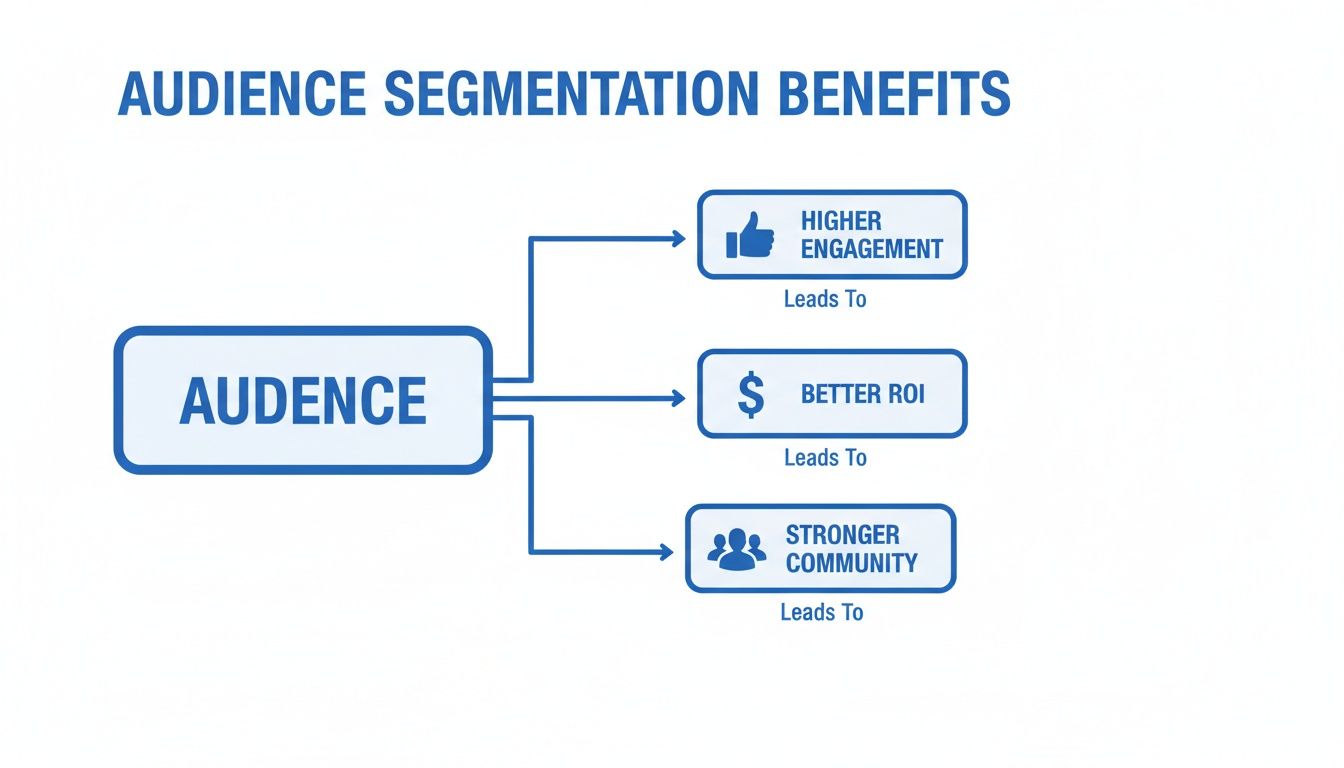
Ultimately, segmentation is a strategic move that directly feeds the core goals every single marketer and business owner is chasing.
This is the most common starting point for segmentation. It's all about grouping people based on objective, statistical data. Demographics answer the fundamental question: Who is in my audience?
It’s the raw data about a person. Think of things like:
Real-World Example: Imagine you're a financial coach. You could create a segment of "young professionals aged 25-35" and share content specifically about saving for a first home. That’s a message that would be totally irrelevant to your retiree clients.
Okay, this is where things get really interesting. Psychographics go beyond the who and dive straight into the why. This method groups your audience based on their internal world—their values, attitudes, interests, and lifestyle choices.
Psychographics are about connecting on an emotional level. It’s the difference between selling a yoga mat and selling a path to mindfulness and stress relief.
Real-World Example: A local coffee shop could target a psychographic segment of "eco-conscious consumers." They’d do this by promoting their sustainable coffee bean sourcing and compostable cups. This message doesn't just sell coffee; it appeals directly to their audience's core values. If you want to nail this, our guide on how to identify your target audience is a great resource.
This one seems simple, but don't underestimate its power, especially if you have any kind of local component to your business. Geographic segmentation is exactly what it sounds like: grouping people based on their physical location.
This can be as wide as a continent or as specific as a single ZIP code.
Real-World Example: A digital marketer hosting an in-person SEO workshop in Austin would segment their Facebook friends by city. This ensures that only people who can actually show up will see the invitation, saving everyone’s time and energy.
Behavioral segmentation is all about action. It groups people based on what they've actually done—their direct interactions with your business, content, and profile. For anyone marketing on Facebook, this is pure gold.
You’re looking at their patterns and history. For instance, you can segment based on:
Example using FriendFilter: Let’s say you're a course creator. You can use FriendFilter to build a segment of "highly engaged but non-purchasing friends." This group is clearly interested and paying attention. You could then send them a personal message with a special, limited-time offer. This is a brilliant way to turn warm interest into a new sale and improve your Facebook reach organically by focusing on the people who are already leaning in.
Alright, let’s get practical. Understanding what audience segmentation is and why it matters is a great start, but actually doing it is what will transform your Facebook presence. Here’s a simple, four-step process to start organizing your friends list today, showing you how a tool like FriendFilter can do the heavy lifting for you.
Before you start slicing and dicing your audience, you need a clear "why." What's the end game here? Your goal is the compass that guides every segment you create and every action you take.
For instance, a coach aiming to find new clients would want to create a segment of friends who consistently engage with business content but haven't signed up yet. But if your goal is just to boost organic reach, your first move should be finding and removing inactive friends.
Get crystal clear on your objective. Are you trying to:
Once you have your goal, it’s time to dig into the data and see who's actually paying attention. You could spend hours manually scrolling through your posts, trying to keep a tally, but that's a recipe for headaches and inaccurate results. This is exactly where a tool like FriendFilter becomes a game-changer.
FriendFilter syncs with your Facebook account and automatically crunches the numbers on your post engagement over a specific period. It gives every single friend an engagement score, showing you at a glance who likes, comments, and reacts to your stuff.
This data-driven view instantly reveals who's really in your corner.
This kind of analysis draws a clear line between your true supporters and the people just taking up space on your friends list.
With real data in hand, you can start building meaningful segments. Don't go crazy and create a dozen groups at once. Just start with a few core segments that tie directly back to the goal you set in step one.
The most powerful segments aren't complicated. They're simple, actionable groups that allow you to tailor your communication and strategy effectively. Start small, test your approach, and expand from there.
Here are three essential segments every coach and small business owner should create first:
Finally, it's time to put these segments to work. Using FriendFilter, you can easily filter your entire friends list by engagement score to isolate these groups. For example, you can instantly pull up everyone with a "0" engagement score to identify your inactive friends.
Once you’ve identified your segments, you can organize them:
By following these steps, you turn a messy, unfiltered friends list into a powerful strategic asset. If you're ready to go even deeper with data, check out our guide on the Facebook Audience Insights tool for more advanced strategies.
You've done the heavy lifting—sifting through your data and pinpointing your key audience segments. Now for the fun part: turning all that insight into actual, measurable engagement. This is where theory gets real, and you start building stronger relationships and getting more eyes on your content.
Let’s dive into a practical playbook for each of the core segments we’ve been talking about.
Think of your "Top Supporters" as your VIPs. These are the people who are always there—liking, commenting, and sharing your posts. Their consistent interaction tells the Facebook algorithm that your content is worth showing to more people.
The goal here isn't just to maintain their engagement but to make them feel genuinely valued. You could create exclusive content just for them, like a behind-the-scenes video or early access to a new product. A simple, personal touch goes a long way, too. Try starting one-on-one conversations in Messenger to thank them for their support or ask for their opinion. It solidifies their loyalty and turns them into true advocates.
This one might feel a bit backward at first, but pruning your friends list is one of the most powerful things you can do for your engagement. Your "Inactive Friends" segment—which tools like FriendFilter make incredibly easy to identify—are users who haven’t interacted with you in months, maybe even years.
Keeping a large number of inactive friends on your list is like trying to have a conversation in a room full of people wearing headphones. It actively hurts your reach because when Facebook shows your new post to this disengaged group and gets no response, it assumes the content isn't interesting and stops showing it to others.
Using a tool like FriendFilter’s auto-unfriending feature lets you safely and systematically remove this segment. This isn't about being ruthless; it's about being strategic. By cleaning your inactive friends, you make sure your content gets in front of your engaged audience first. This gives it a massive initial boost and signals to the algorithm that it's worth showing to even more people.
Our guide on how to measure social media engagement dives deeper into why these numbers matter so much.
Your "Potential Leads" segment is where the real opportunity lies. These are the people who consistently engage with your business-focused content but haven’t yet converted into a customer or client. They’re warm, they’re interested, and they’re often just waiting for the right nudge.
Your strategy should be all about authentic connection, not a hard sell. Start a conversation based on a comment they left. For instance, you could send a message like, "Hey [Name], thanks for your comment on my post about X. I saw you were curious about [topic], and I thought you might find this article helpful." You're providing value without any pressure.
To really see what’s working, practices like social media monitoring can give you real-time feedback on how people are reacting. It helps you see what's truly connecting so you can fine-tune your outreach and build stronger relationships with your most promising leads.
To bring it all together, here’s a simple table showing how you can approach each segment with a clear goal and an actionable strategy using FriendFilter.
By tailoring your actions to each specific group, you stop shouting into the void and start having meaningful conversations that drive real results.
It’s easy to get excited about audience segmentation and dive in headfirst. But a few common mistakes can trip you up, leading to a lot of wasted effort and frustration. Let’s talk about these roadblocks so you can navigate around them from the very start.
This is probably the biggest trap marketers fall into. In the quest for perfection, it's tempting to slice your audience into a dozen tiny, ultra-specific groups. The problem? You end up with analysis paralysis.
Trying to create unique content for too many segments makes your strategy a tangled mess. Worse, the groups become so small that you can't get any meaningful data from them.
What to do instead: Keep it simple, especially at first. Start with just 3-4 core segments that directly support your main business goals. Think in broad, high-impact categories like "Top Supporters," "Inactive Friends," and "Potential Leads." You can always drill down and get more specific later once you have more data to work with.
Your audience is constantly changing. People's interests shift, their engagement patterns evolve, and what was true six months ago might be completely irrelevant today. Using old data to guide your marketing is like trying to find your way with an old, crumpled map—you're bound to get lost.
Your audience segments are living, breathing groups, not a one-time setup. Regular maintenance is the key to keeping them relevant and effective, ensuring your messaging always hits the mark.
To stay on track, you have to refresh your data on a regular basis. A simple, effective routine is to use a tool like FriendFilter to re-analyze your engagement every month or so. This ensures you’re always targeting the right people and know exactly who’s gone cold. For more on this, our guide on how to increase your Facebook reach organically is a great resource.
Knowing your audience’s age or location is a start, but it only scratches the surface. It tells you who they are, not why they should care about what you have to say. When you focus only on demographics, you miss the motivations and behaviors that actually drive connection.
You might know you're talking to a 40-year-old woman, but do you know why she’s interested in your coaching? Is she looking to scale her business or find a better work-life balance? Demographics won't tell you that.
What to do instead: Go beyond the basics and layer in behavioral insights. Pay close attention to what your friends actually do on your profile. Use engagement data to see who consistently likes your business posts, who watches your videos, and who clicks your links. This action-based approach gives you a far richer understanding of what they truly want, helping you create content that resonates on a deeper level. A big part of this is regularly cleaning your inactive friends so your engagement data stays sharp and accurate.
Still have a few things you're wondering about? Let's clear up some of the most common questions people have when they start thinking about audience segmentation.
Think of your audience segments as living, breathing groups, not a static list you set and forget. A good rule of thumb is to review them at least every quarter.
Of course, if you see a big change in your engagement or your business goals shift, don't wait. For a segment like your "Inactive Friends," you could run a tool like FriendFilter every month. This keeps your audience fresh and signals to the Facebook algorithm that people are genuinely interested in your content, which is key to increasing your Facebook reach organically.
You sure can, but be prepared for a serious grind. The manual route usually means firing up a spreadsheet and meticulously tracking every like and comment on your posts for weeks on end.
It's tedious, time-consuming, and honestly, pretty easy to mess up. A tool like FriendFilter automates the entire process. It crunches the engagement data for you, instantly showing you who’s tuned in and who's tuned out. This saves you a ton of time and lets you make decisions based on real data, not guesswork.
Nope—quite the opposite. Regularly cleaning your inactive friends list is one of the best things you can do to boost your account's health and reach.
Here’s the simple reason why: Facebook's algorithm shows your new posts to a small slice of your friends first. If that initial group doesn't interact, the algorithm assumes your content isn't very interesting and stops showing it to more people.
When you remove friends who never engage, you're essentially guaranteeing your content gets in front of your real fans first. This sends a strong positive signal to the algorithm, telling it your posts are valuable and worth showing to a much wider audience.
Ready to stop guessing and start connecting with the right people on Facebook? FriendFilter gives you the data you need to identify your top supporters, remove inactive friends, and boost your organic reach. See the difference for yourself with a free 14-day trial. Start your trial today!