Learn how to find coaching clients with a practical approach: define your niche, craft offers, and leverage social media to attract ideal clients.
FriendFilter scans your Facebook and shows exactly who's inactive — so you can clean up and boost your reach.
Hey there, coach! Before you can even think about finding coaching clients, we need to get crystal clear on two things: who you serve and the specific problem you solve. This isn't just some marketing fluff; it's the absolute foundation of your business. Get this right, and every social media post, every conversation, and every offer you create will land perfectly. Skip it, and your message will just be noise.
You can't find your future clients if you don't know exactly who you're looking for. I see so many coaches fall into the trap of casting a wide net. They call themselves a "life coach" or a "business coach," thinking it'll attract more people, but it does the opposite. Those broad labels just get you lost in a sea of thousands of other coaches saying the same thing.
Here's the truth: if you're trying to talk to everybody, you end up talking to nobody. The secret to standing out is specificity.
Think about it. Instead of being another "life coach," what if you were the go-to expert for new moms struggling to rebuild their careers after a five-year break? Now that's a niche. You've instantly gone from a generalist to a specialist.
Having a well-defined niche isn't about limiting your potential clients; it's about focusing your power where it counts. When you are laser-focused on who you help, every piece of content, every conversation, and every offer you create will resonate on a much deeper level with that specific group.
This focus helps you:
As you start to build your practice, remember that all the best strategies to get more clients begin right here, with this critical first step.
Once you’ve nailed down your niche, it’s time to build out a detailed Ideal Client Profile (ICP). This goes way beyond basic demographics like age or location. A truly effective ICP dives into the psychographics—the beliefs, frustrations, and secret desires of the person you're truly meant to serve.
A powerful ICP goes beyond who your client is and explores what they truly want, what frustrates them, and what keeps them up at night. This emotional insight is your greatest marketing asset.
Let's walk through building your ICP. Grab a notebook and answer these questions:
Getting this foundation right is the single most important thing you can do to consistently find coaching clients. To really go deep on this, check out our guide on how to identify your target audience, which gives you a full step-by-step framework. This clarity will become the bedrock of your entire client-finding system, making everything else that follows so much easier.
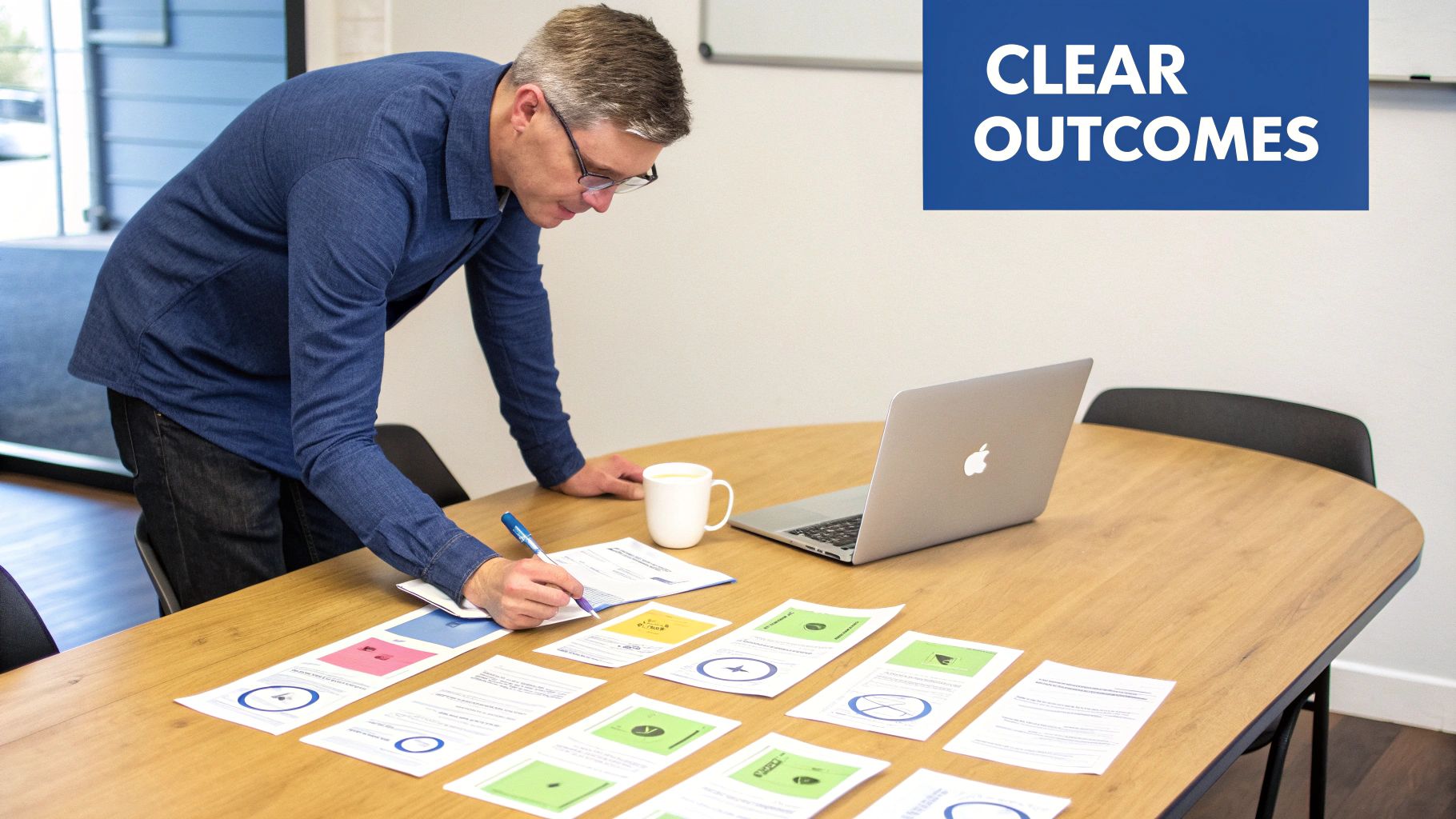
Now that you have a sharp, clear picture of your ideal client, it's time to build the one thing that will make them stop dead in their tracks: your irresistible offer. This isn't just a list of calls and worksheets. It's the bridge that takes them from their biggest frustration to their most desired future.
A great offer doesn't sell coaching—it sells a transformation.
The most powerful offers feel like they were created just for the person reading them. They hit on the exact struggles you uncovered when defining your ideal client and lay out a clear, compelling path to the outcome they're dreaming of. Forget vague promises. We're talking about tangible, specific results.
Here's a critical mindset shift: Your clients aren't buying your time. They're buying a solution to a problem that's costing them sleep, money, or peace of mind. The first step is to stop selling "sessions" and start packaging a "solution." It seems like a small tweak in wording, but it has a massive impact on how your offer lands.
For example, instead of listing "12 one-on-one coaching sessions," frame it as a complete program designed to get a specific result. Something like a "90-Day Career Accelerator for New Managers" sounds infinitely more valuable than just a package of calls.
Your offer has to answer one simple question for your ideal client: "Will this get me the specific result I want?" If the answer isn't a loud, immediate 'yes,' it’s time to head back to the drawing board.
A killer coaching offer is way more than a price tag. It’s a well-structured package that blends your expertise with the exact support your client needs to actually get results. While every offer is different, the ones that consistently convert almost always include a mix of these key pieces.
Before someone is ready to drop thousands on your high-ticket offer, they need a taste of the value you deliver. That's where a lead magnet comes in. It’s a completely free, high-value resource that solves a small but urgent problem for your ideal client.
The goal isn't to give away the farm; it's to provide a quick win that builds trust and showcases your expertise. This freebie should be the logical first step someone would take before they're ready for your full program.
For instance, if your main offer is a business coaching program for freelancers, a great lead magnet could be a "Freelancer's High-Converting Client Proposal Template." It solves an immediate, painful problem and naturally leads them to wonder what other systems you could help them build.
This strategy is foundational to finding coaching clients consistently because it builds a pipeline of warm, qualified leads. By giving away incredible value upfront, you make it an easy "yes" for them to take the next step. To learn more about getting the right eyes on your content from the start, check out our insights on how to increase Facebook reach organically.
As your friends list grows with these ideal prospects, you'll need to keep it healthy. Our guide on how to use FriendFilter to remove inactive Facebook friends can help ensure your audience stays engaged. A clean list means your valuable content is always seen by the right people, which is crucial for nurturing those leads into paying clients. And don't forget, a powerful lead magnet deserves to be seen, so learn how to increase engagement on Facebook posts to maximize its visibility.
When you're trying to figure out how to find coaching clients, your personal Facebook profile is one of the most powerful, and often overlooked, tools in your arsenal. Before you even think about complex funnels or spending a dime on ads, you can build real momentum right where you are.
This isn't about blasting your friends with offers. It’s a step-by-step approach to building genuine trust and positioning yourself as the go-to expert in your niche, making ideal clients want to work with you. Let's walk through how to turn your personal profile into a client-generating machine.
Your Facebook profile is your digital business card. Whenever you comment in a group or send a friend request, the first thing people do is click on your name to check you out. What they find can either make them click away or draw them in.
Think of your profile as the front door to your business. It needs to instantly answer three questions for any visitor: who you are, who you help, and what they should do next.
Here’s a quick step-by-step checklist to get it set up for success:
These simple tweaks transform your profile from a casual social space into a strategic asset that works for you around the clock.
Facebook Groups are where your ideal clients are already hanging out. They're gathered in digital communities, asking questions and talking about the very problems you solve. Your job is to simply show up and be helpful.
The golden rule here is to give, not take. The fastest way to get banned and tarnish your reputation is to join a group and immediately drop a link to your offer. Instead, focus on adding massive value.
Here's an actionable plan: Spend just 15-20 minutes a day engaging in two or three key groups. Hunt for questions you can answer with genuine insight. Share your expertise, offer encouragement, and be a helpful voice without asking for a single thing in return.
When someone engages with your thoughtful comment, that's your green light. Send them a friend request with a simple, personalized message. "Hey Jane, loved your perspective in the Marketing Masters group! Wanted to connect." This authentic approach is the perfect first step to moving a prospect from a public group into your personal network. It’s one of the most reliable ways to generate high-quality leads on Facebook without being salesy.
Your authority isn't built by what you promote; it's built by what you freely give away. Consistently showing up with valuable advice in relevant Facebook Groups is the ultimate long-term strategy for attracting high-ticket clients.
Once people accept your friend request, your profile content is what nurtures that new connection. Every post should aim to do one of three things: demonstrate your expertise, showcase your personality, or spark a conversation.
A great content mix educates, entertains, and inspires. Take the executive coaching market, for example. It's a booming industry where coaches can stand out by sharing unique, valuable content. This market is expected to grow from $103.56 billion in 2025 to a staggering $174.53 billion by 2031, fueled by a huge demand for leadership development. With North America making up over 40% of this market, there's a massive opportunity for coaches who can share their knowledge effectively. You can learn more about the growth in the executive coaching industry and see the potential for yourself.
To get started, here's a sample content plan. Think of it as a template you can adapt to your own coaching niche.
This simple schedule helps you consistently post valuable content that builds authority and attracts your ideal coaching clients directly to your personal profile.
Remember, every post is an opportunity to start a conversation. When people comment, reply to every single one and ask follow-up questions. For the best comments, take the conversation to DMs with a natural opener like, "That was such a great point you made on my post! Tell me more about..." This is how you build real relationships that seamlessly lead to discovery calls.
Relying solely on Facebook is like building your dream house on rented land. It's a fantastic starting point, but a single algorithm change can disrupt your entire business overnight. To build a truly resilient coaching practice, you need to diversify where your clients come from.
This isn't about being everywhere all at once. That's a recipe for burnout. The idea is to strategically add a couple of new channels to your playbook, turning each one into a reliable stream of high-quality leads. Let's look at a few powerful options to expand your reach without losing your mind.
If you coach professionals, executives, or B2B clients, LinkedIn is non-negotiable. It's where you shift from building community (like on Facebook) to building serious authority. This is where the decision-makers you want to work with are spending their time.
The first step is to turn your LinkedIn profile from a resume into a high-octane sales page. It needs to speak directly to your ideal client the second they land on it.
Once your profile is dialed in, your content needs to match the platform. LinkedIn rewards deep, industry-specific expertise. Forget the personal updates; share sharp analysis of business trends, unpack common leadership challenges, or break down a client case study.
Here's the hard truth: your social media following is borrowed. Your email list? That's an asset you own. You're not at the mercy of an algorithm to reach your audience, which makes it the perfect channel for building deeper relationships.
You don't need a crazy, 50-step automated funnel to make this work. The goal is simple: deliver consistent, undeniable value straight to their inbox.
Your email list is the only marketing channel you truly own. It's a direct line to your warmest leads, allowing you to build trust and demonstrate your value away from the noise of social media.
Just start with one high-value email per week. This isn't a sales pitch. It’s an extension of the value you're already providing elsewhere. Share a quick client win, a powerful mindset shift you've observed, or a practical tip they can use that day.
To keep your pipeline full and consistently find new coaching clients, it's wise to diversify with proven top lead generation strategies for businesses. This creates a more stable and predictable client acquisition machine.
Paid ads on platforms like Facebook or LinkedIn can be like pouring gasoline on a fire—but you need to have a fire first. Dropping money on ads before you know your message works and your offer converts is one of the fastest ways to burn through cash with nothing to show for it.
Think of ads as an accelerator, not a magic bullet.
Don't even think about paid advertising until you can confidently say "yes" to these three things:
Once you've hit that point, ads can be a game-changer for scaling your impact. You can run ads to your lead magnet, a free webinar, or directly to an application for a discovery call. By building a solid organic foundation first, you ensure your ad budget actually delivers a profitable return.
Getting leads is one thing, but that’s really just the starting line. The real art is in turning those initial sparks of interest into actual, enrolled clients. This is where you shift from marketing broadcasts to genuine, one-on-one connections.
Let's walk through a simple, repeatable playbook for taking someone from a DM to a discovery call, without ever feeling like a pushy salesperson.
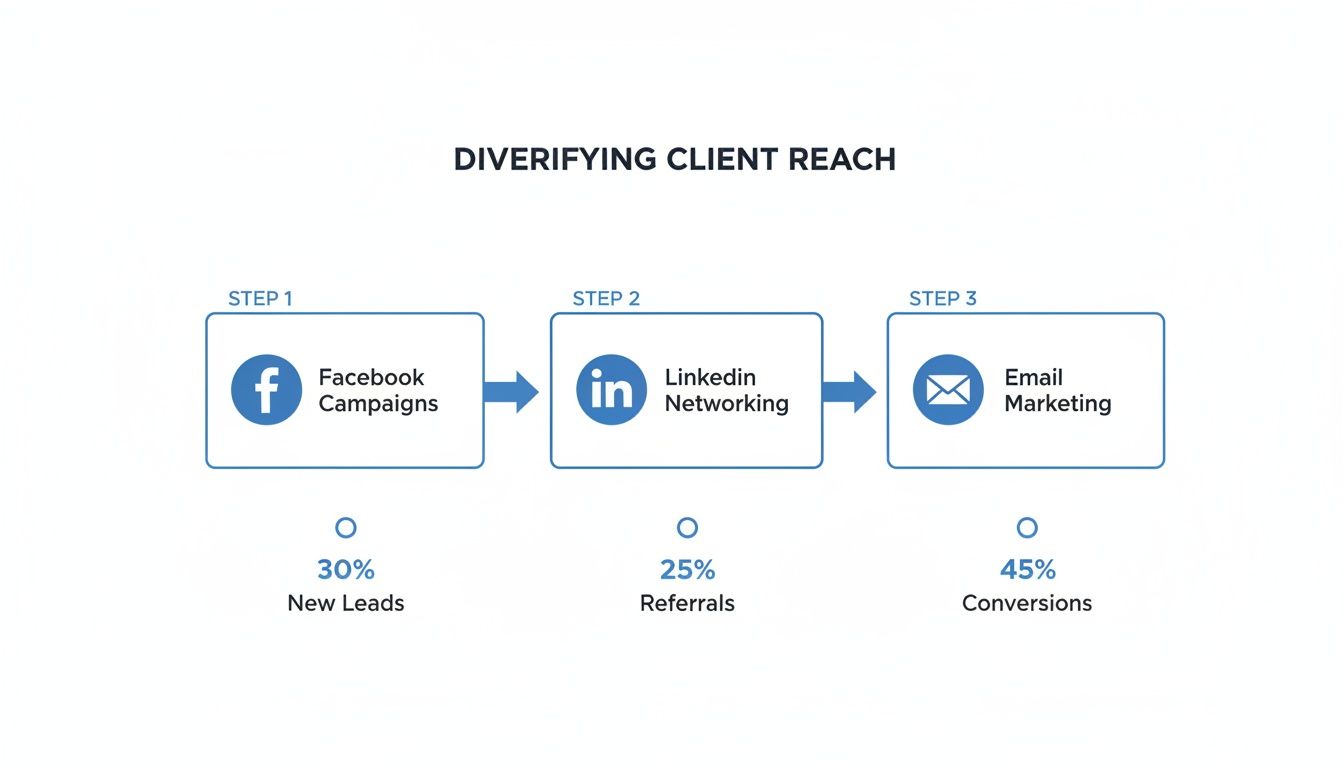
This visual really nails a core concept: you can’t put all your eggs in one basket. By spreading your efforts across Facebook, LinkedIn, and email, you create a much more stable and predictable flow of new conversations.
That first DM is a huge sticking point for so many coaches. The fear of sounding spammy is real, but a thoughtful, personalized message can open doors you never thought possible. Your goal isn't to pitch—it's to start a real conversation.
For instance, say someone leaves a great comment on one of your posts. Instead of just "liking" it, you could send them a message:
"Hey [Name]! I really appreciated your comment on my post about [topic]. Your point about [specific detail] was so insightful. I'm curious, what's your biggest challenge with that right now?"
This works so well because it’s:
From there, the conversation can flow naturally. By asking about their challenges and goals, you'll quickly get a sense of whether they might be a good fit for what you do.
Once the chat reveals a potential need, the next logical step is to invite them to a discovery call. You can keep it super low-pressure. Try something like, "It sounds like you're working through some big goals. I have a few ideas that might help. Would you be open to a quick, no-pressure chat next week to explore them?"
The discovery call isn't a sales pitch. Think of it as a clarity session for them. Your only job is to listen intently and guide the conversation.
Here’s a powerful 4-step structure I’ve seen work time and time again:
This process naturally positions you as a trusted guide, not a salesperson. For a deeper dive, check out our guide on how to properly qualify sales leads, which has some great tips for identifying your ideal clients during these calls.
Look, not everyone is going to sign up on the spot. That's perfectly normal. Having a simple follow-up plan keeps you top-of-mind without being annoying. A day after the call, send a quick email summarizing their goals and how you see your program helping. If you don't hear back, a gentle check-in a week later is totally fine.
It’s an exciting time to be a coach. The industry is exploding—the global market size is projected to hit $5.34 billion in 2025. That’s a massive 62% jump from $2.85 billion in 2019, and some forecasts even predict it could reach $9.5 billion by 2032. These numbers aren't just stats; they represent a huge, growing demand for skilled coaches who deliver real results.
Finally, you have to track your metrics. Knowing your numbers is the difference between guessing and growing. Keep a simple spreadsheet tracking how many DMs you send, how many calls you book, and your closing rate. This data is pure gold—it tells you exactly what’s working so you can do more of it.
Even with the best playbook in hand, you're bound to have questions. It’s part of the process. Let’s walk through some of the most common hurdles I see coaches face, whether they're just starting out or have been in the game for a while.
This is the big one, isn't it? The good news is the answer isn't some mythical number—it's just simple math, tailored to your life. You need to reverse-engineer your income goals.
First, figure out the monthly income you need to live comfortably. Don't forget to add a buffer for business expenses and taxes! Once you have that magic number, just divide it by the price of your main coaching package.
Yes and no. Offering a free discovery call or a "clarity session" is a fantastic, industry-standard way to connect with potential clients. Think of it as a consultation where you diagnose their main problem and show them how your paid coaching is the cure.
But—and this is a big but—you should not give away full coaching sessions for free. Doing so sends the message that your time isn't valuable and tends to attract people who aren't truly committed to solving their problems.
Your free call is a diagnostic tool, not a free sample of your entire program. Use it to showcase your expertise and build trust, making the transition to a paid engagement feel like the logical next step for the right person.
Building a blog or an email list is a brilliant long-term play, but let's be honest, it takes time to get the ball rolling. If you're looking for the fastest way to get that first paying client, it’s all about direct, authentic outreach.
Get on platforms like Facebook and LinkedIn where your ideal clients are already hanging out. Dive into relevant groups, start real conversations in the DMs, and focus on being genuinely helpful. You'll almost always land your first client this way much faster than if you just sit back and wait for them to find your content.
The timing couldn't be better. The professional coaching market in the U.S. is on track to be worth $16 billion in 2025, with over 232,000 coaches helping people. That's more than double the size of the industry back in 2016. You can read more about the professional coaching industry's rapid expansion. All this growth means one thing: your ideal clients are out there, right now, looking for exactly what you offer.
Ready to turn those Facebook connections into a predictable stream of coaching leads? FriendFilter helps you clean your inactive friends, identify your most engaged followers, and boost your organic reach. Start your free 14-day trial today and see how easy it can be to attract your ideal clients. https://friendfilter.com